About Us
The Research Centre
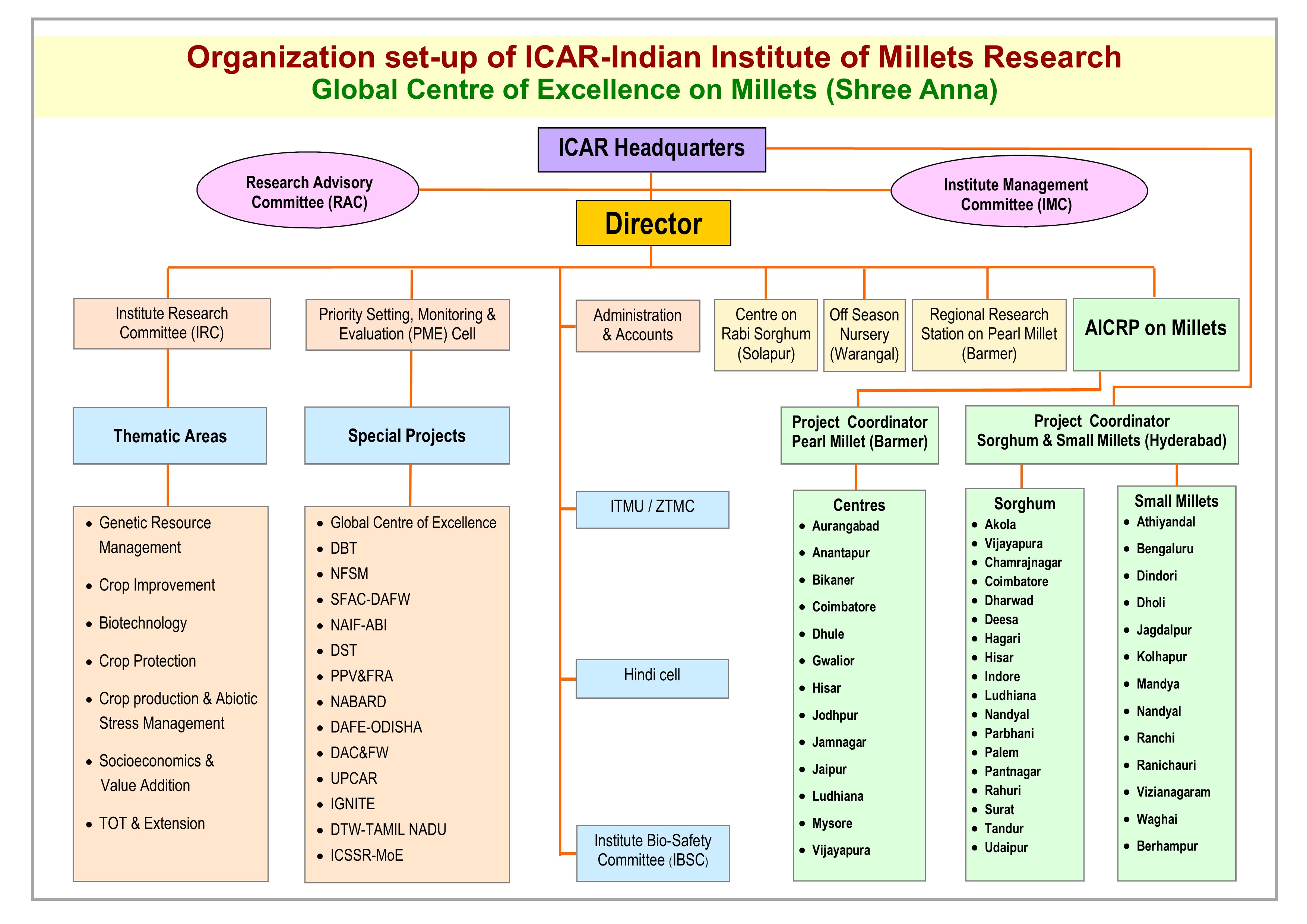
 The ICAR-Indian Institute of Millets (Shree Anna) Research (IIMR), Hyderabad, is the premier research organization dedicated to basic and strategic research on millets crops. It has been set up under the Department of Agriculture Research and Education (DARE) under the Ministry of Agriculture & Farmers Welfare, Government of India. Originally established under PIRCOM in 1958, was established as the National Research Centre for Sorghum in 1987. It was elevated to a full institute with all millet crops added to its research repertoire in 2014. A defining milestone in its history occurred on March 18, 2023, when the Prime Minister dedicated IIMR to the nation as the Global Centre of Excellence on Millets (Shree Anna), positioning it as a worldwide hub for sharing best practices, research, and technologies. It has two regional centres- Centre for Rabi Sorghum at Solapur, Maharashtra, and Pearl millet Research Station at Gudamalani, Barmer, Rajasthan.
Vision
Our vision is to transform subsistence farming of millets into a globally competitive climate-resilient Nutri-cereal enterprise through crop improvement and value-addition to meet food, feed, fodder, nutrition and biofuel requirements of the country for equitable prosperity.Mandate of IIMR
- Basic and strategic research to increase productivity of millets and their diversified utilization for enhancement of profitability.
- Coordination and development of improved crop production and protection technologies of millets.
- Training and consultancy on millet production and utilization.
- Dissemination of technologies and capacity building.
Evolution of the Institute at a Glance
Global Centre of Excellence in Millets (Shree Anna)
Major components of the Global Centre of Excellence in Millets are:
• Establishing Global Germplasm Medium-term Storage Facility to Strengthen Millets GeneBank for Conservation, Trait-specific Characterization and Utilization of Millet Biodiversity for Crop Improvement
• Global Technology Innovation Centre for Trait, Seed and Crop Improvement of Millets for enhancing Yield and Productivity
• Nutricereal Analytical, Food Safety and Quality Assurance National Referral Laboratory for Millets
• Global Centre of Excellence for Millet Value Chain for Entrepreneurship, Incubation and Start-up Nurturing
• Establishment of International Knowledge, Skill Development and Capacity Enablement Centre with International Millet Museum & Halls of Residence.
• Global Facility for Millet Pilots on Feed, Fodder, Biofuels, Malting, Brewing and Promotion of Industrial utilization of Millets
• Regional Millet Technology Innovation and Outreach Hubs
Research Platforms & Infrastructure
The institute has developed core strengths in millets field and laboratory research infrastructure, millet genetic resources, expert and trained manpower and extensive network with national and international agencies to complement the mandate of the institute.
The recent additions include institute's specialized infrastructure, including state-of-the-art genomics labs, climate-controlled germplasm repositories, high-throughput phenotyping facilities, and specialized computational resource allocations for handling massive data loads like genomic simulations.
Advances in Research
The institute’s research mandate encompasses crop improvement, genomics, and climate resilience. The crop improvement programmes include developing superior parental lines, high-yielding varieties, and heterotic hybrids designed for unique agro-ecological zones. Breeding objectives heavily prioritize elevated grain-zinc and iron densities (biofortification) alongside increased stalk biomass and juice quality for dual-purpose sweet sorghum and forage systems.
A major recent scientific breakthrough was the decoding of the first chromosome-scale genome of little millet, unlocking new avenues for trait improvement. During the last 5 years IIMR has aggressively expanded the genetic base of millets, releasing 16 varieties, including biofortified and industrial-use varieties such as the brown midrib sorghum CSV 59 BMR for livestock digestibility and sweet sorghum CSV 58 SS for biofuel. Notable small millet releases included CLMV-1 (biofortified little millet), CBYMV-1 (barnyard millet) and CFxMV-2 (biofortified foxtail millet). It manages the Millets Genebank, conserving over 49,779 germplasm accessions.
Technology outreach
Farmer Producer Organizations: Functioning as a Cluster-Based Business Organization (CBBO), IIMR supports over 41 Farmer Producer Organizations (FPOs), directly benefiting over 200,000 farmers and other stakeholders by integrating them into sustainable value chains and enhancing farm incomes.
Collaboration with Central and state governments: ICAR-IIMR actively works with ministries in the central governments and state governments as technical partner to promoter millets production and consumption in the country. IIMR has played a key supportive role in the millet programmes in the states of Odisha, Karnataka, Maharashtra, Andhra Pradesh, Chhattisgarh, Maharashtra, Assam, Kerala, Tamil Nadu and others.
Global Leadership and Policy Impact
IIMR served as the primary technical and research anchor for the International Year of Millets (IYM) 2023, driving a "Jan Andolan" to rebrand millets as "Nutri-Cereals". On the global stage, the institute facilitates cross-border collaboration as the secretariat for the MAHARISHI (Millets And OtHer Ancient Grains International ReSearcH Initiative), a G20 initiative. The value-added technologies developed by IIMR are contributing to the inclusion of millets in the government programmes. IIMR has supported FSSAI to set the millets product profiles for national grades and standards.Nutrihub-TBI: Nurturing the Agri-Startup Ecosystem
Hosted by ICAR-IIMR with initial support from the Department of Science & Technology (DST), Nutrihub-TBI (Technology Business Incubator) acts as the central destination where millet-based ideas, agripreneurs, research experts, and funding bodies converge to create a market-driven knowledge economy for "Shree Anna".
Technology Consultancy & Business Facilitation: Nutrihub provides handholding support, market analysis, and business plan formulation while granting startups access to IIMR’s proprietary food processing technologies.
Infrastructure Facilities & The Common Facility Centre (CFC): Nutrihub operates pilot-scale manufacturing and testing labs that allow incubatees to test, refine, and standardize new millet food products under expert supervision without high initial capital investments.
Access to Funding & Brand Awareness: Managing seed-stage financial pipelines—including the RKVY-RAFTAAR grant-in-aid programmes-while simultaneously leading nationwide promotional campaigns to drive consumer demand for millet value added products.
Through Nutrihub, IIMR has catalyzed a startup revolution, providing technical training to over 253 startups and 488 entrepreneurs, and licensing technologies for ready-to-eat and ready-to-cook products.
Intellectual Property & Technology Management
The translation of laboratory research into commercial applications is governed by the institutional Technology Management Unit (ITMU), operating under the guidelines of ICAR’s decentralized IP management framework. This unit manages the techno-legal landscape required to protect and license IIMR’s expanding research outputs.MAHARISHI
MAHARISHI Initiative (https://maharishi.res.in/ ): Launched during India’s G20 Presidency in 2023, the Millets And OtHer Ancient GRains International ReSearcH Initiative (MAHARISHI) established a global framework for research on climate-resilient grains. With the secretariat based at ICAR-IIMR, Hyderabad, the initiative is now in its post-2025 “Implementation Phase," focusing on connecting international research centers to bridge gaps in research and open-access data sharing with regards to ancient grains.